Thursday, April 16, 2020

This is Where We Are - The Walls Inside Part 5


It is unseasonably cold in New Orleans. I feel like I would know this from the light on the wall even if I could not feel this fact. The wind, in gusts, sounds cold.

I am looking at these blank walls. One wall is hardly blank because the sunlight is flashing on it. There are the two empty hooks where the painting on paper hung.

It is late (for me), 9 in the morning. My mind is already full, cluttered. My children are up and talking and moving through the house. I am sitting on my bed trying to look at blank walls. Children abhor a vacuum.

I want the vacuum to tell me something but walls speak in soft voices. Tomorrow, when the house is quiet I will be back here listening.


Tuesday, April 14, 2020

Saying Nothing - The Walls Inside Part 4

There. 

Before today, my goal was to look at what I had painted, to see where I had been in order to see where I was going. Maybe that failed. Or maybe this was where I was going. It necessarily was.

Now my goal is to sit with nothing to see what belongs there. If anything.


Monday, April 13, 2020

Containing Everything - The Walls Inside Part 3

My last two posts addressed two paintings on the walls of my bedroom. They were there so I could consider and reconsider them and they would, I thought, inform what I make next. This painting of the Citadelle de Sisteron (oil on canvas) is on the bedside table. 

I first painted the citadel on gessoed paper. I could not initially remember where in southern France the citadel had been so I sent a message to Michaela who identified the photograph or painting, whichever I sent, as Sisteron. I was painting on paper but was preparing to move to a larger scale and had ordered beautiful, large stretchers from Maine. At the time, it seemed I would begin working on this large scale on canvas and stick with it for a while, but the shift in scale (and surface) would inevitably present some problems. The attempt to paint the citadel large scale (maybe 5 x 6 feet) failed. I had too quickly given up articulating the large forms and too soon began painting detail. Also, my painting sessions were too short to make a complete pass on this larger space and on this more thirsty surface. There was no cohesion in the image and the painting was quickly looking overwrought and unstable. I unstretched the canvas and returned to this smaller scale to try to look more carefully at the few basic forms that made the composition.

Those days I was committed to making paintings that were self-contained, that said everything they had to say within their four edges and did not rely on a series or on installation to articulate something. I had also begun to think of certain source material as having special qualities or special potential. This was opposite of the practice of painting almost arbitrarily images I came across or photographs I had shot from the hip. The special potential I looked for in a photograph to use as source material was that it “contained everything.” This was the phrase I gave it. Or, "everything is there." I would go through a pile of photographs and set aside the ones that were different. I relied on a kind of intuition. Then I would have to paint them to really know. I was painting a lot on paper in oil and for the first time in my life returning over and over to the same image. 

The photograph painting of the citadel is based on, taken from a car as I drove through southern France with Michaela, did not on the surface look special. But it contained a mountain, which had been carved into a citadel. I had believed that this was a monastery and that informed my understanding (or misunderstanding?) of the image. Citadel or monastery, fittingly, at that time I considered my practice cloistered, private, and detached from any career intentions or concerns of audience. I had no need to say or write down what I was doing or why, a kind of vow of silence, so any attempt to put my ideas about a sacred image or a painting containing everything are loose translations of thoughts that occurred without words.

This painting did contain everything I knew in that moment. It is a humble claim and a humble painting because while it contained everything I knew, I really didn’t know much and what I knew was vague. So this painting, here on my bedside table is not so much an unfinished thought but one of the last completed gestures I made before moving out of my studio. 

I am looking at this painting of the citadel now. My goal was to look at these paintings on view in my bedroom all along, but I at some point I stopped seeing them. I am looking at this painting now and I see its derivative passages: the shape of the trees a little Doig-y, the palette a little more Tuymans-y than is my own, though black is there and that is for me the essential element. Can something be derivative and honest? 

Not to cut myself off (but, yes, to cut myself off), I think it’s time to take these three paintings down and store them. I see now I was not looking at them as I intended to do and they were just taking up space.


Thursday, April 9, 2020

Forgetting to Remember - The Walls Inside Part 2

In my last post I wrote that I sometimes hang my own paintings on my bedroom wall so I can consider unfinished thoughts they embody or because they are positioned between what I made and what I will make next. I do not hang a painting I made on my wall because I think it is some amazing thing. 

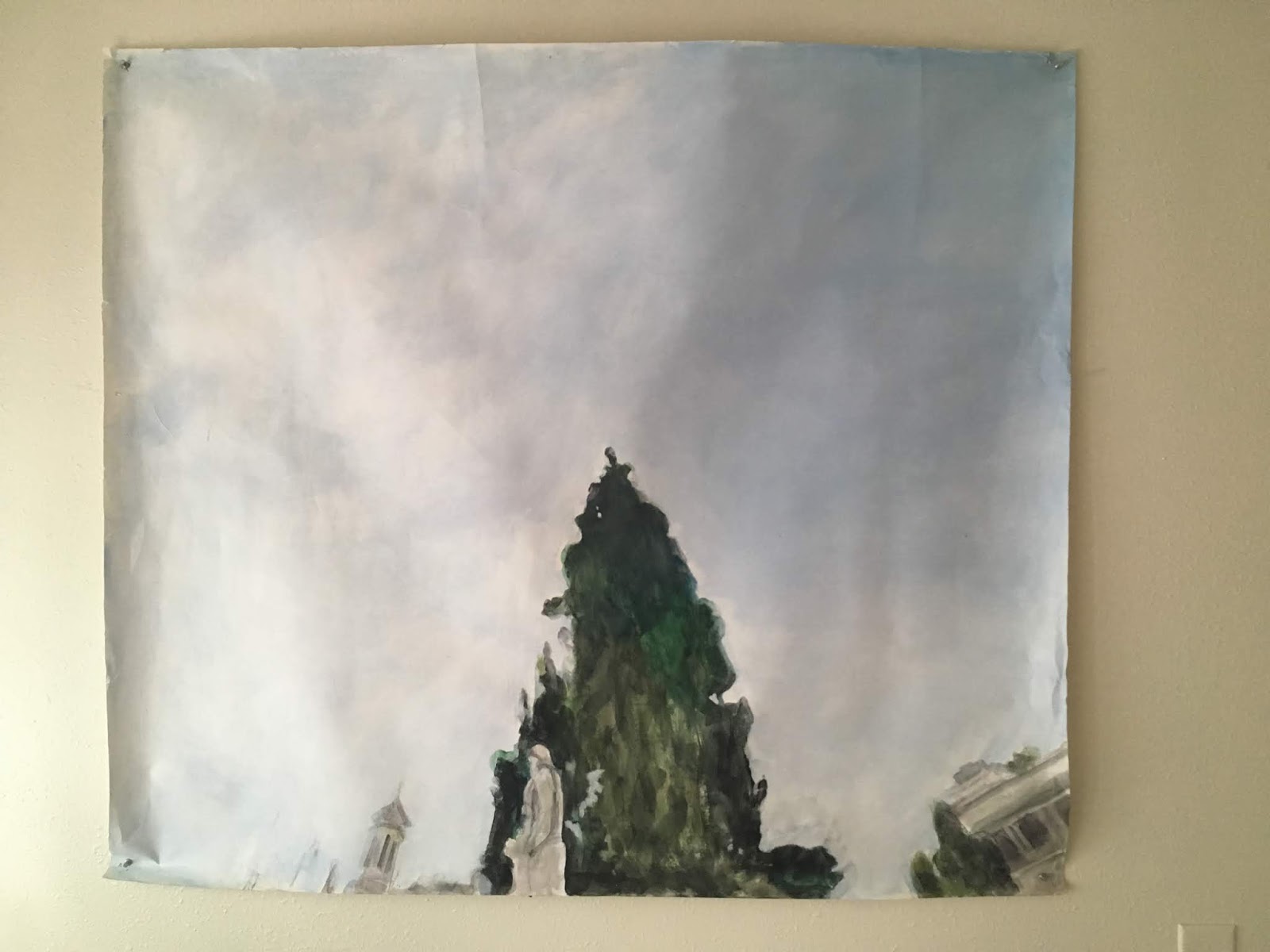
I painted this acrylic painting on paper (48 x 56 inches) years after spending an evening in the Piazza del Popolo with Jake and Laura. It was the night Jake and I arrived in Rome, my first trip abroad. When I painted it, the time and place I was thinking back on (fifteen or so years before, the Piazza del Popolo, Rome, Italy) seemed to belong to someone else. And now the time and place I painted it (maybe five years ago here in New Orleans), seems to belong to someone else as well.

Is the subject of the painting a tree and some sky or is the subject something else? Is the subject Returning? After all, I directed Google Street View here and not somewhere new and not somewhere I was planning to go. Click by click I returned to circle the piazza, where I spent one evening fifteen or so years before.

I hung this painting on my wall so I could look at it again, so I could answer the questions it poses and get on to other things. It occurs to me that I have only looked at this painting peripherally since hanging it on my wall. Looking at it now is not so pleasant.

There is a wrinkle, two actually near the top of the paper. They were made when my son, two or three years old at the time, fell on the painting, which was rolled up and somewhere safe I thought. There was confusion on his face when he saw that my concern was for the painting rather than him. I had seen immediately that he was not hurt, but he was used to see me orbit him, a planet with no name, little gravity of my own. Even if he had gotten a bruise, it would be healed and forgotten by now as he has forgotten this moment. But the wrinkle in the painting is still there.

The wrinkle was there when I included this painting in a casual little show in a gallery that would be home to an artist collective for a few years. The space had just been converted from a daycare to a gallery with several small studios for rent in the back and it was walking distance from my house. I would have a studio in that building, various spaces actually, four in all, over the next few few years, but I would not join the collective. When we hung the show I pointed out the wrinkle to one of the other artists. “I sort of like it, she said about the wrinkle.” She followed up with a reason but it was not interesting to me. That comment has stuck with me and annoyed me and it has outlived the gallery, the studios, and my knowing this person. It doesn't really matter that there is a wrinkle in this painting but it certainly wasn't and isn't some good thing. It is funny that this wrinkle, this scar in the paper, has become such a significant landmark in this painting which is not significant. 

The wrinkle is not what makes looking at this painting now, writing about it, sort of unpleasant. Is there a significance to this painting on my wall? Is there a thought or a story behind it? Is it about Jake and Rome and retracing steps, in rummaging in the past? Is it about painting on paper rather than canvas, about working on a new scale and having that experiment cut short when I had to move out of the studio the in the middle of a life upheaval that required all of my resources? It strikes me as funny now that the dominant backstory of this painting seems to be about a wrinkle, an inconsiderate toddler and the tenacity of identity, a comment that for some reason has bothered me for years.

This painting on paper (and not on canvas stretched on the posh custom stretchers that left my studio with everything else in the back of my friend's pickup truck in the wake of a life upheaval) does not asked to be considered important. The painting asserts itself only as a passing thought, and not an idea or belief. There is something immediate in the image I painted. It is also awkward. The perspective follows the Google Street View fisheye lens, which I raised upward above the concerns of map navigation to see the top of that poplar tree.
Just as the view overlooking the Mediterranean (in the painting on the opposite wall) was not about David, this painting is not about Jake. But Jake is there somewhere, isn’t he? 

In the Piazza del Popolo there are four statues, personifications of the seasons of the year. In Google Street View, years after leaving Rome, I circled the piazza click by click as one circles the years and then stopped at the spot where we sat on a bench drinking red wine, Jake and Laura and I. I turned the virtual gaze upward as I turn my physical gaze upward to wonder about this thing that is hanging on my wall. What did I want to remember to think about later? Is there something I am forgetting to remember?


Sunday, April 5, 2020

The Walls Inside Part 1: Where Do We Come From...Where Are We Going?


The self-isolation mandate and the shutdown of physical cultural spaces has me looking at my own walls.

Generally I do not decorate my walls with paintings I have made. (When I display other people’s paintings I don’t really think of them as decoration either.) But when I used to live in spaces where I rented a single room and shared a kitchen and bathroom, I would fall asleep and wake up looking at the paintings I was working on.  This habit has persisted. Though I am not painting at the moment (other than little watercolors) I have on the walls of my bedroom two paintings that represent an unfinished thought. Though the paintings themselves have been finished for some time, there is in each of them something I will pick up again.

This is an oil painting on paper. I painted it from a photograph I took in France. I am pausing now, trying to remember if I was with David when I took this photograph and where exactly it was. It was near the Mediterranean and David was there for sure. 

The composition of this painting is not a composition I gravitate to, not a composition I have used before that I can remember. That and the calligraphic black trees not representing my usual shorthand or gesture make this painting a little alien to me even though I am the one who painted it. I notice the halo around the two branches cropped on the left hand side. I notice the slight curve of the horizon line. There are wisps of white paint, smoke, that may be exaggerated but that remind me of Provence and the smell of burning grass. And this is fire territory, there had been fires that year and I wonder now if my knowledge and memory of fires informed the way I drew the trees, which look charred, though I do not recall the trees in the photograph were burnt. There is pink in the foreground that almost looks like an accident but reminds me now of when the wind came across the Mediterranean from North Africa sometimes it carried sand from the Sahara and left it on the windows and cars in outside Marseille. But that had not happened when this photograph was taken and not when David was there. 

I am thinking of how some parts of this painting, the alien facts of these–I do not want to say decisions because when one is painting it becomes a kind of séance, a thing only part under one's control, part not–these marks, these material utterances, seem to come from someone else. But I was someone else when I stood there taking a photograph on the passenger side of the car David had been driving. And I was someone else a couple of years ago when I painted it. And I am someone else now when I am writing about it. 

This view is rare for another reason: I have not usually been drawn to representing scenes of the water, views of the sea. Even when I have lived near the water, I spend a lot of time turning around, my back to the water. In beach towns I like to look leave the beach and walk to see things a block or two away. I don't think this painting is really considering at the water. Maybe I remember now, stopping the car with David, looking at the road snaking behind us, looking at the road ahead that went to the sea.

This painting was the result of a gesture of looking around, a gesture I made standing outside of a car in southern France a long time ago. It is also the result of a decision to make a trace of paint on a piece of paper some years later. About a year ago, looking back and squinting forward I hung this painting on the wall. These words are the result of my still standing here trying to figure out where I have come from and where I should go from here.


Friday, February 14, 2020

The Best Art I Saw This Week Was a GIF


It has been a hard week for my heart, not the medical one, the other one. I will leave it at that. A GIF is most effective when sent quickly as a reply, as if it were a card already in your hand, ready to throw down. I Googled “faceplant GIF” or “face-down GIF” on my phone, on my lunch break, to express to a friend in one little moving image how I was feeling, or more likely to avoid expressing seriously how I was feeling.

I found this stunning GIF of Superman. He is lying facedown by a pastoral wall, his body motionless, a detail emphasized by his cape blowing in the wind. I admit I was feeling raw anyway but when I saw it my heart (maybe the medical one) contracted. And it issued an electric impulse to my brain that became this thought: our love relationships serve the purpose of keeping our heart aware of itself.

Our other profound relationships, our friends, family, mentors, these relationships usually do not force us to feel the (not medical) heart in the same way our love relationships do, like a sickness even. In love, in the beginning or end or in times our love relationships struggle, the heart makes us aware of itself, a raw and frantic muscle. Falling in love, our heart feels lung-sized, swollen, electrified, pumped with endorphins and speed. In times of hurt, it feels like it took a major league pitch, stunning and bruising, concussing it. When it refuses to feel, it feels calcified, a small, cold stone. This GIF pressed on the bruised, fist-sized (not medical) muscle of my own heart saying “yes, it hurts right here.” I looked at the GIF all day.

The background in the GIF, which I assume was taken from an older–maybe water colored episode of Superman?–shows detail and distance. Beyond the dirt road, the wall, the row of trees, a ploughed field, there is a tree line. This is our world. I do not think of Superman cartoons as having particularly developed backgrounds, but the trees are so verdant and there is real air and atmosphere. I am drawn into that distance but here is Superman in his distinctive, primary colored costume, his muscles super-developed, and he has been knocked down. It could have been Kryptonite but it could have been something else, something more human. Anyway, he is hurt. Superman is hurt. 

If art is a designation, not market-made or requiring a special stamp, but determined by the way something lands in one's sensibility, this is the best art I have seen this week or month or maybe ever. I can’t stop looking at it even though it hurts.


Tuesday, September 10, 2019

About Whitespace


Sunday morning I had the feeling that everything was crushed up against something else. When I texted a friend asking if he had read some book, he replied that he was salivating at the idea of silence in the house where he could read for an hour not having had that in a “long long long time.” I responded that I was fantasizing about whitespace. I wanted to wrap myself in whitespace. I wanted to install whitespace around each thought, action, and obligation. The whitespace would be made of physical space, silence, and time. I drew a bullet point in the middle of a big, blank text message. He asked me to explain. 


Student Work
White space in art is also called "negative space." When I was teaching foundational drawing to first-year college students, I used chairs to demonstrate negative space. Students would draw, in charcoal pencil, the contour not of the chairs but the space surrounding the chairs. The students would then fill in the shapes made by outlining the background, in other words the negative space. The shape of chairs would emerge. 


These days, it’s as if nothing has negative space around it. One thing (one responsibility, email to answer, thing to order) overlaps another. Therefore, it is hard to see the shape of things.


I like reading books with lots of whitespace.


The White Cube is a term describing a certain art gallery aesthetic. The white cube is whitespace in cubic feet. I like the white cube. I like the controlled context, the minimizing of distractions, and the implied assertion that what you see in here attempts to address the notion that things have meaning.

I would like to put everything in my life in its own white cube, not only the painting I am working on, but the Entergy bill, my broken car window, my son’s socks on the floor. Then maybe I could see what they all mean.

And people, everyone to whom I owe a phone call or an hour, I’d like to put them in—or more politely, invite them to—a white cube gallery. I could go and see them in the near-void. Maybe it would be like Marina Abramović’s The Artist is Present  without all of those museum-goers watching. (Meet me at the white cube at 4 o’clock. I will see you—like really see you—there.) 


All day Monday I thought about whitespace. 

I turned off NPR to try to hear the whitespace. 

I imagined my sons surrounded by it as they walked into school. 

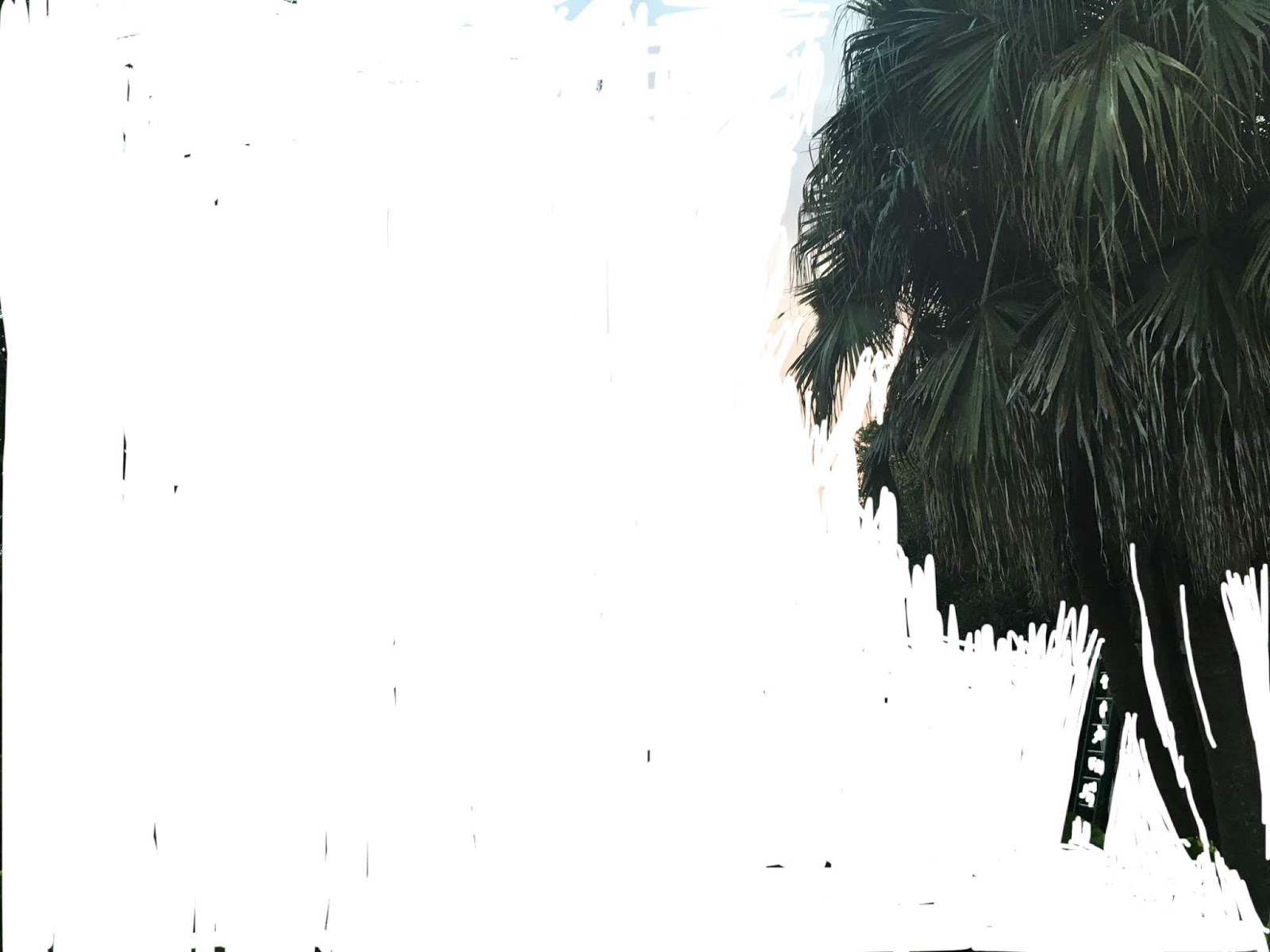
I took a photo of my yard and whitewashed everything but the ladder to the shed roof (roofs are great for finding whitespace) and the palm trees. 

And last night I looked in my art books for whitespace (Toba Khedoori, Rachel Whiteread, Michael Landy...).


My Books

This morning, it occurred to me that whole breath thing with yoga might be about creating internal whitespace.


l(a by e.e. cummings


e.e. cummings knew a thing or two about whitespace.


I guess this is not new to me. As I was writing I remembered a painting I made in grad school that was about ten feet wide and four feet tall. It was all white except for on one side a silhouette of a man and on the other a silhouette of a dog. I found other images of old work that also prove this is not the first time I have thought about or engaged in whitewashing, if that is what it is.


Untitled, In-Progress Grad School Painting
Untitled, Grad School Painting (detail)


If I could have a superpower right now, this would be it: 

to make space where there isn’t enough space, 

quiet where there isn’t enough quiet, 

and time with nothing in it where there is no time with nothing in it.


I am more human than super. And like almost everyone I know, I am overwhelmed. 

But after thinking about whitespace I am committed to try to find more whitespace, 

to profit from nothingness, 

and maybe where I can't find space, time, or silence, try to create it.


Yard With Whitespace

Untitled (People on a Beach in California) Acetone Print With Graphite and Colored Pencil


Sunday, February 17, 2019

Three Paintings by Patch Somerville at The Front

AROUND 100 WORDS
(Above, Below Left, Below Right) Patch Somerville at the Front
The two larger, more figurative, more advantageously placed paintings broke the spell of the three smaller, more interesting ones. Of the small paintings, one suggested landscape, one still life, one, portraiture. They formed a trio about genre, subverting genre expectations at the same time. Nothing novel, but the voice was distinct and believable. These paintings were also about paint and painting as most good paintings are, to the faithful, anyway. There was no list of works, and the gallery attendant could not tell me if the paintings were titled or not. Bummer.


Monday, February 4, 2019

Art Books


AROUND 100 WORDS
Vitamin P: New Perspectives in Painting
I stopped buying art books when I moved to New Orleans. Our apartment didn’t have central air. Mold and probably insects were consuming my collection. We, a family of three then four, didn’t have the resources to sustain this habit nor was I in the same mind-set. As a grad student or a young(ish) painter living in New York, I had been addicted to Phidon art book porn, the glossy, sexy, presentations that one could heavy-breathe over in some craigslist dump. They took these big messy things—paintings—and made them intimate, private, your connection to them felt real. You too would be a star.

Tuesday, November 13, 2018

Village Disco, Displacement, and David Bordett at the Front

David Bordett, The Patient Gothic Chisel, The Front
I was at Holly’s drinking an Aperol spritzer. Tom, who is a writer, was sitting across from me. I don’t know Tom well but I see him from time to time at the grocery store, at literary or art events and we have some friends in common including Holly. Tom asked me why I had stopped writing my blog, which I kept for two years and stopped writing in 2016. He turned to his wife and said, "She was writing a blog about displacement. It was called…” and he looked at me. "Village Disco,” I said.

That was more than a month ago and I am still thinking about what Tom said: A blog about displacement. I had believed I was writing a blog about art. 

“The election.” I said, answering Tom’s question about why I had stopped writing my blog in 2016. Everyone nodded slowly as if saying, well, of course. But it wasn’t quite true that I stopped writing about art because of the election; it definitely wasn’t the whole truth. The last post I wrote was a response to the election, and after the election I did feel a version of what the late night comedians would say in those days “…because nothing matters anymore.” In fact, it was not that art mattered less to me at that time, but that it mattered more. I wanted to be in the quiet of the studio painting more than I wanted to be looking at and writing about art exhibitions. At the time I was painting landscapes from photographs I had taken of the Luxembourg gardens and Parc des Buttes Chaumont in Paris. I was also painting a pine tree that had been in the yard of the house where I lived near Marseille in 2004.

Five out of six of us around the table at Holly’s had moved to New Orleans from New York about a decade ago and within months of each other. The conversation had moved to New York and what living back there, now, would be like: the cramped living spaces, the pleasure of reading on the subway, and that here we have our own yards for our children to play in. 

A blog about displacement.

Had this been a blog about displacement? I went back and had a look at my blog entries, keeping an eye out for clues. I found that I often asserted my expectations of a gallery, complaining when work was hung too high or too cramped, but couldn’t those expectations have formed anywhere including New Orleans? Maybe not. I wrote a whole piece about the weird habit many New Orleans galleries had of playing background music as if a gallery were a furniture store. In that post I do not reference other places but I think the way I refer to New Orleans is accented, obviously not native. A glaring “I’m not from here” post was my reaction to the Katrina reflection show titled Ten Years Gone at NOMA and my irritation at a reviewer who seemed miffed that not all of the work or artists screamed NOLA! at the viewer. I mention in various posts and in various ways that my expectations were formed elsewhere, my New York perspective transported in my carpetbag. Like this, in the second post on the blog I wrote:

The expectations I arrived with were formed in New York and New York is easy to feel homesick for even if it is not your place of birth, even if you (sometimes) remember well all its frustrations on many fronts including art. The thing about making and looking at art in New York is that is so, serious. Also, it feels part of something global. When I moved here I couldn't even get a handle on the local use of the vocabulary I thought was universal in contemporary art.

I end the post with a nostalgic Google Street View grab of West 19th Street and wrote as if trying to convince myself, “I live here now, in New Orleans; David Zwirner does not. I’m okay with that. Mostly.”

Displacement. Displacement. I repeated the word until I almost lost its meaning. And what does this have to do with art?

I told Holly and Tom and the others that last summer I stayed alone in my brother’s Bronx apartment when he was out of town. One night I had the windows open. I stood by the open window and I thought, funny, it’s quieter here than in my house in New Orleans and the air smells better. I thought vaguely of the word, belonging. The next day I went to the Met and looked at French paintings of gardens and parks.

***

Lately, I have been considering writing about art again. Tom's comment about displacement kept mixing with that consideration and so I went to see what was on view at The Front.

In the second gallery there was a show of works by David Bordett titled The Patient Gothic Chisel. There were three sculptural works and one photograph on view.

The wall labels for sculptural works were detailed and abundant lists of materials. When an artist does this, the materials can take on a kind of poetic weight. Included in the list of media on the wall label next to Reliquary was “Christian Louboutin red flocking” and “stalactites recovered from the exterior of the cloisters.” I asked the artist (who was gallery-sitting that day) to clarify a couple things. “What is Christian Louboutin flocking?” I asked (outing myself as more of sneaker and boot type) and by “the cloisters” did he mean “The Cloisters?” as in the New York museum. Once I had that information (Louboutin, the fashion designer of the red-bottomed stilettos, and yes, The Cloisters) I went back and looked at the piece for a long time. It was hard not to enjoy the light-absorbent red fabric, the meticulous (Gothic?) details including the lancet window cubby that held the relic, the so-labeled stalactite from the outside of the cloisters.

I remembered the first time I visited The Cloisters on an afternoon many years ago. It was spring, and I had taken the subway north to Washington Heights, to a part of the city that was new to me. And I remember daffodils and the view of the Hudson River looking almost like a painting from another another era. The air was new and clean-smelling. I was with my sister and it is one of my fondest memories of being with her, though the memory is thin in story and detail. My memory merged with the “relic” in the gallery and I thought, memory itself is a relic that cannot be encased.

Next to Reliquary was a photograph. It pictured the base of a stone wall, part of a recessed column, and an outlet with an iPhone charger and phone plugged into it. Last summer when I was at the Met with a dying phone battery. I stopped near a little display of books and things to buy, not near any artworks, and I plugged in my phone. A minute or two later I was politely told by a passing guard that I could not plug in my phone there. Looking at the photograph I let out a little, spontaneous laugh. This photograph was one of those artworks that was completed not on the wall but in my mind as the viewer. The particular sum of my traveled path—the cloisters all those years ago, my attachment to old European stone, my experience last summer at the Met, and my vague and persistent longing that envelopes art, Europe, and New York—made this work speak to me. It was not a blockbuster work of art but it moved me.

The title of the photograph was The Patient Gothic Chisel. The photograph’s title made a funny little comparison between the sturdy tool that had presumably shaped the stones pictured and the fragile and antsy little iPhone sucking up electricity, loaded with concerns about being liked.

My experience of the remaining two pieces in the show paled in comparison, though, as I have admitted, this comparison is based largely on subjective and nostalgia-tinged experience. The two remaining works stirred no memory, and so for me operated as a bit of pleasing eye candy. The unicorn (titled Superleggera) was easy to like though I thought the painted unicorn and color on the base were redundant and unnecessarily distracting. The piece titled Many Paths seemed both democratic and slightly cynical, saying something between Joseph Campbell’s The Hero with a Thousand Faces and “Whatever.”

Before I left I talked for a while with the artist. He said he used to live in New Orleans, comes back frequently, but now lives in New York. I did not know the neighborhood he named when I asked where in the city he lives. This happens more and more. I asked about Greenpoint like it was an old friend. I have not been back to Greenpoint for a few years now, maybe avoiding it when I return to New York because everyone I knew there is gone, and on the streets one hears more English than Polish which makes me uncomfortably wistful. Two women visiting the gallery overheard us talking and said they were from New York, neighborhood: Williamsburg. We all talked for a while about neighborhoods here and there, rent prices here and there, and art here and there.

Before I left I told David Burdett that I have a friend, Holly, who used to work at the Cloisters. But she lives here now. I’d like for her to see your show.

David Bordett,  Reliquery, The Front


David Bordett,  Superleggera, The Front

David Bordett, Many Paths, The Front